
Joseph Victor Lansing
Major Joseph V. Lansing: 93 missions with the 79th FG, provided by his daughters Carolyn Gunn and Susan Lansing Dubbs

European Theatre: Italy
2nd Lieutenant: February 1944
1st Lieutenant: September 1944 Captain: April 1945
FROM DAD’S BIO WRITTEN BACK IN 1951: When I was a kid, I read a lot about World War One aviation. Most of it was pulp magazine variety, but I liked it immensely. I had to fly. In 1938 I did manage to get in a limited amount of private flying. By 1941, I was married and the Air Corps didn’t accept married men for cadet training. In 1942 this restriction was dropped and I immediately passed the entrance exams with a better than average grade. All my training was in the Southeast. I wasn’t over-confident, but I did want, more than anything else, to be an Air Force Pilot. I graduated with the Class of 44-B, took single-engine fighter transition at Tallahassee, and later joined the 79th Fighter Group on Corsica. I few 93 missions in 275 hours, returned to the States in July of 1945 and was released from active duty on November 9, 1945. Continuous participation in the Reserve program enabled me to maintain flying proficiency. Our unit was recalled in March of 1951 and I was ordered to active duty with the 31st Fighter Escort wing at Turner AFB in Savannah. Because of civilian training, I was immediately transferred to Purchasing and Contracting under the Air Base Group. In December 1951, I was appointed an Air Force Contracting Officer by SAC headquarters. Like most pilots, I would prefer a full-time flying job to administrative duty; however, I feel that the work I am doing is of definite value to the Air Force. I think I am contributing to the accomplishment of the overall mission of the Air Force. I hope to increase my knowledge and efficiency to a point where it equals the pride I have in being an Air Force officer. There is no finer organization.

BASIC FLYING SCHOOL SHAW FIELD SUMTER, SOUTH CAROLINA Nov 10, 1943
…You’re not far wrong in your assumption that we’re doing some pretty hard work here. Basic flying school is one of the toughest of the lot. The transition from light primary trainers to these souped-up BTs is a considerable jump. In this ship, we have a multitude of additional instruments and controls. …In ground school, we study stuff like Radio Communications, Navigation, Flight Instruments, Aircraft Recognition, Code and Meteorology or weather, weather and more
weather…Meteorology seems to be the toughest one of the courses and about the only one that causes any appreciable loss of sleep… Last week, an order came out prohibiting us from doing any spins or acrobatics until further notice. I think it’s a little matter of frayed control cables in about 60 percent of the ships here. They’ll be replaced soon and we can go back to the right kind of flying. I never was any good at straight and level…
…Truthfully, there’s never a dull moment in this flying business. It’s the most exciting and adventurous thing I’ve ever done. It’s a barrel of fun, but you have to stay awake. Brother Gremlin is always gunning for you. Eighty-eight percent of the accidents involving aircraft is due directly to pilot failure. There’s too much neglect to detail and caution by a large number of students who just fly for the fun of it. Most of them have to learn the hard way. That usually means somebody gets hurt. I’ve seen it happen.
ADVANCED FLYING SCHOOL MARIANNA FIELD
WE’RE OFF…
Preflight is behind us now and the job of separating “the men from the boys” is all but complete. Maxwell has seen to that. With high hopes and great vigor, we anticipate

Primary…learn to fly, ears burning from our instructors’ description of our ability as aviators. Solo, stretch our fledgling wings in flight—a day of days. Maneuvers—chandelles, lazy eights, spins, then twenty-hour-check—do we worry? And how! More flying time, greater precision and a growing confidence in ourselves—forty-hour check. The final lap—that awesome last flight examination and on to Basic…Formation flying, link trainer, night flying, and cross-country. Not in a bucking old Stearman, but a “hot” job that demands real flying ability of its pilots. Fly plenty and work hard until at last we’re at…. 
Advanced. Specialization….speedy single-engined A-Ts for the fighter pilots and complex twin-engine Cessnas for the bomber men. Learn to fly with many others in a tight, neat formation—wing tip to wing tip—roaring through the skies. Combat maneuvers, long cross-country hops—tests which try our every ability as pilots and men on the ground as in the air, until that great day when our ideal becomes a reality—our wings.

P-40
It sure is a wonderful hunk of junk. It sure is an earth-lovin’ critter, though, just get’er up high, point her nose down, and she really scats. Shove on full throttle and it begins to talk in hundreds of miles per hour than miles per hour. Durn thing’s got more meters to read, buttons to push, switches to throw, and gadgets to gadgeteer than anything I’ve ever run across. Hell, it’s a combination of slot machine, juke box and eggbeater rolled into one. JVL, April 15, 1944.
ON TO EUROPE AND THE PLANES HE FLEW

P-47
Joe named his P-47 “Ampersand” for the “&” symbol, meaning “and,” because “something always comes after it.” He later attributed its massive 2500 HP engine to saving his life when he crash-landed in Italy.

Yep, I was in on the invasion here. I was over the beachhead before “H” hour and saw the whole show. Good show too. We moved up to S. France as soon as we could get located. It was too far from Corsica. Moved up again the other day to our present location not far from a city that has just been liberated. We were the first here and the French almost mobbed us. Funny as the devil to have some old mustached Frenchmen come up and kiss you on both cheeks. They think the yanks are heroes, and “peelots” are the nuts….(Sept. 6, 1944)

SHOT DOWN ON ONE OF JOE’S WW II 93 MISSIONS


LETTER TO HIS SISTER, NOVEMBER 20, 1944 (regarding being shot down)
Dear Kids, (he’s referring to his sister and her husband as ”kids”) Guess I got the biggest story to come outta’ the war as far as I’m concerned. Here ‘tis. Well, we went to Yugoslavia yesterday on an armed ready strafing show. Went down and shot up one locomotive west of a big city there. I was pretty well outside of the town when I hit a jerry airfield. I pulled off to the left on the deck and opened fire on a twin-engined ship, an HE 111, and set him afire, then shot an FW 190 fighter all to hell. There was a solid wall of 20 millimeter flak on the airfield and I was hit—bad. I didn’t know it though so I started a turn to the left. I was gonna come back and clobber some more of those planes. Must’ve been at least fifty of ‘em on that field. Then,
I noticed my engine was smoking badly and throwing oil all over the windshield. So I started a gradual pull up. I called Capt. Slatton and told him my trouble. Old Slats really stuck with me. He got on my wing and directed me all the way back. There was so much oil and smoke that I couldn’t breathe except through my oxygen mask (and all my oxygen was shot out.) I just hung the hose out in the slipstream on the side that wasn’t smoking. Had to fly instruments all the way back. I kept 7500 feet and 200 mpg all across the Adriatic. I was so afraid she’d dump me in the cold drink and I’d have to take a swim. Anyhow, I sweated that oil pressure all the way back. It kept painfully dropping down. Twenty miles from the coast I started letting down. I wanted to increase my airspeed and hasten a landfall. Got down to 3000 feet and one mile from shore my propeller went out. With only ten pounds of pressure (normal 90 pounds) left, I started turning up 4500 rpm (normal 2500). Of course, I began to lose airspeed and altitude fast. Slats tried to guide me to an emergency airstrip but I had oil all in my eyes—I couldn’t see nuttin’. Finally, I spotted the strip. 90 degrees on my right and I was paralleling it. I thought I’d swing around and make it from the west. By this time my power was completely gone. I already had my wheels and slaps down for a normal landing. I knew I was going to crash so I tried to pick ‘em up. No soap. My hydraulic system was shot all to hell so they didn’t come back up.
Anyhow, I went in about half a mile off the end of the runway. I hit the trees at 150 mph. I was blind as a bat and had to feel for the ground, She chopped off heavy trees like match sticks. Then she hit the ground and I didn’t slide ten feet. Went right over on my back. Well, I thought I had it for sure then. I felt her going over and then the canopy smashed all to hell on the ground. I don’t think I was unconscious but a few seconds cause I started scrambling to get
out. I was hanging on my safety belt. I released it and fell in a heap. Then I crawled through a small hole in the glass. One time it paid to be a small feller. When I saw that the ship wasn’t gonna’ burn, I crawled back and cut off all the switches. The Limeys had a medico out there thirty seconds after I crawled out. He was a swell egg, brandy and all. Anyhow, as I was crawling out of the cockpit, 50 caliber machine gun bullets started exploding and kicking mud in my face. That was hell. The ship was completely a total wash out. Everything was gone. Both wings sheared off, the tail torn off and the whole body crumpled. Two 20 mm shells exploded directly behind my head, but thanks to the armor plate, the skull is still intact. Nobody can understand how I got out alive; neither can I. That two yards of steel (the engine) out front is the only thing that saved me. The cockpit alone didn’t crumple. Last thing I did –fore I went in was lock my shoulder harness. There are a thousand and one ways I could have been killed in that crash. I took care of that one. God must’ve taken care of the rest for me. No doubt about it, God was really my co-pilot yesterday. He and I are great buddies now and I’ll never let him down. I wasn’t badly hurt. I got cuts on my left leg and a terrific bruise. The stick hit me so hard that it snapped in two. Had a cut on my left hand and bruises on my right leg. My ugly puss wasn’t touched. Dammit—plastic surgery might’ve done big things for me. I won’t walk for a couple of days, but should be back flying soon. I’m pretty damn mad right now. That’s the first time I ever scratched the paint on a ship (did a hellava good job though) and I’m telling you, some jerry is gonna’ pay for it. If that’s the most damage they can do me, they’d better dig ‘em some deep holes, cause I’m going on a panty scorchin’ spree.
Lots of love, Joe
HONORS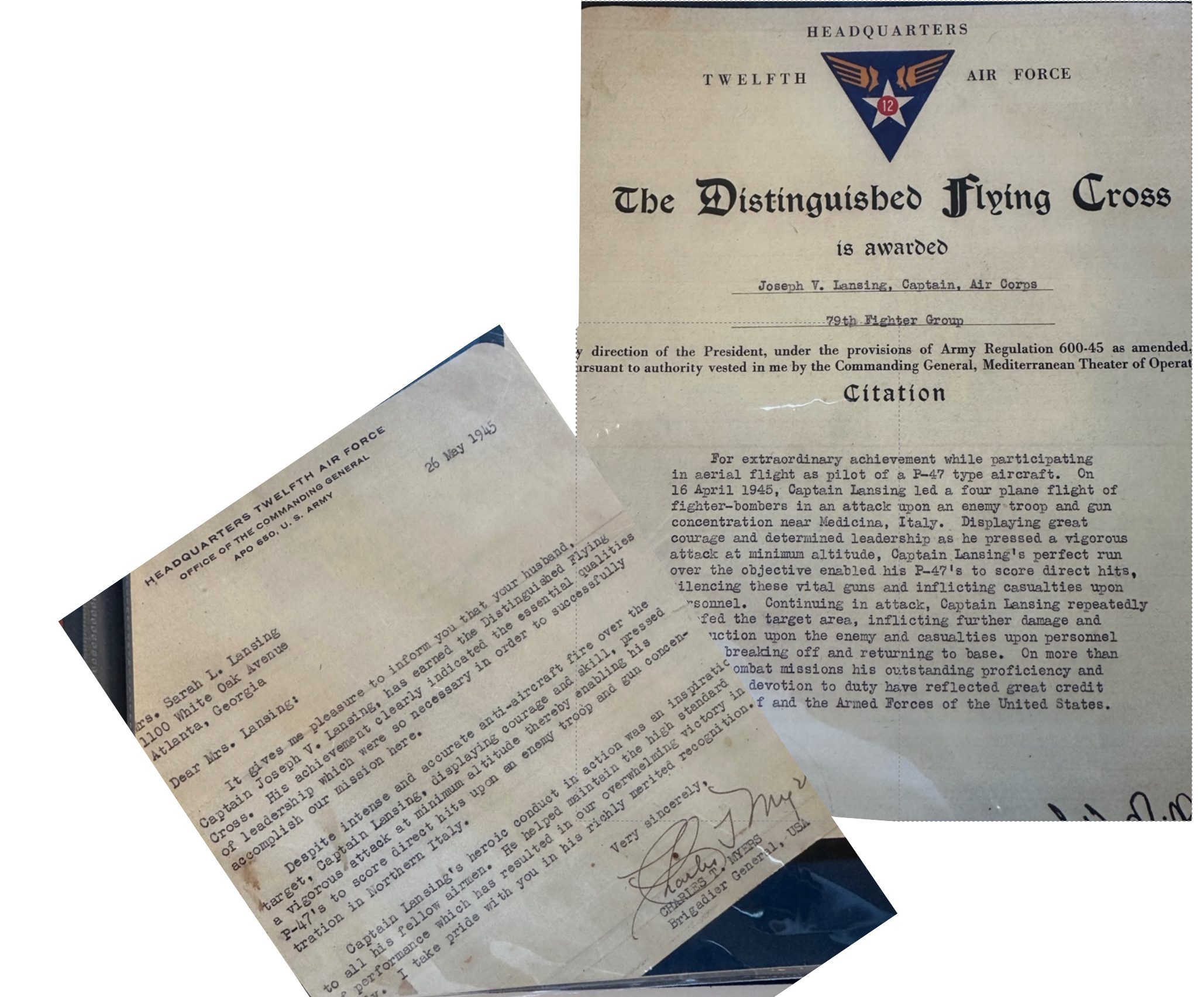

VICTORY IN EUROPE

BIOGRAPHY:
Dad was born in Sanford, Florida on Christmas Eve 1918. He grew up on the east coast of the US in Sanford, Philadelphia and on the eastern shore of Maryland, ultimately moving to Atlanta as a young man. In 1938, he married Sarah Coffee, a native Atlantan, who remained the love of his life for 60 years when she passed away. Dad worked at Atlanta Paper Company for the next few years of his married life prior to joining the service.
Joe enthusiastically joined the Air Force and served three years during WWII and two years during the Korean Service, retiring with the rank of major. He was a member of the 79th Fighter Group, which supported the British Eighth Army when German General Rommel threatened to take Cairo. Afterward, his fighter group was reassigned to support, again, the British Eighth Army in their campaign on the Adriatic Coast of Italy, ending with the May 1945 surrender of Germany. During his service, Joe flew 93 combat missions and was awarded the Distinguished Flying Cross, Air Medal, four Oak Leaf Clusters and the Purple Heart.
Joe served as Office Manager and Atlanta District Sales Manager for the original Fafnir Bearing Company, which became a division of Textron, Inc. in 1968. For thirty-five years, he proudly represented the company, the manufacturer of the highest quality precision ball bearings, dedicated to supplying and serving the aircraft industry, machine tool and agricultural machinery manufacturers.
He and Sarah welcomed their first daughter, Carolyn Jo in 1945, followed by a second daughter, Susan Leigh in 1953. The Lansings lived in Atlanta their entire lives, having four grandchildren and five great-grandchildren.
Joe was proud of his life of his service in the Air Force and the contribution he made to the freedom we continue to enjoy today.